
Resurrection Lutheran Church, St Catharines
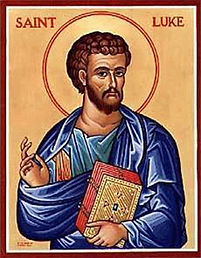
The Feast of St. Luke, Evangelist
October 18, 2026; Thomas Krahling, Seminarian
Please use this web site merely as
an introductory step to
attending services in person.
What our Lord does for us in
His presence in the Divine Service
cannot be recreated here or
through any technological medium.
Christ Sends His Ministers To Bring Peace to a Hostile World
Today’s Gospel recalls how Jesus sent out seventy-two men to proclaim peace to a hostile world. Jesus
knows about the different dangers the Church has from her enemies, so he sends out these missionary
pastors with special instructions meant to teach them to trust in God for everything. He sends them out with
a simple message: “Peace be upon this house.” Even though the world is a dangerous place, Jesus promises
these pastors that they will find a home among the people who receive them. Jesus designs Christian
churches to be held together by his own peace, which comes from heaven and fills the church. Pastors and
their people are tied together by the love of Jesus.
[1] So he begins by saying, “Behold, I am sending you out as lambs in the midst of wolves.”
In this life, our Good Shepherd leads his sheep through the valley of death. He knows that the world is full
of dangers and opposition. Christians face a unique kind of hostility, which we call, ‘persecution.’ In our
epistle today, Paul warned Timothy about Alexander the Coppersmith, who opposed the gospel and did Paul
great harm. We don’t know much about Alexander, but if he was a coppersmith from Ephesus, then it is
likely that he joined Demetrius the silversmith in persecuting Christians. When Demetrius saw that Paul’s
Gospel would threaten their business, crafting and selling statues of Greek gods and goddesses, the
metalworkers incited a riot, and drove Paul out of town.
Or consider the Samaritans. When the days drew near for Jesus to be taken up, he set his face to go to
Jerusalem. And he sent messengers ahead of him, who went and entered a village of Samaritans, to make
preparations for him. But the people did not receive him, because his face was set toward Jerusalem. When
his disciples James and John saw it, they wanted to retaliate. “Lord, do you want us to tell fire to come down
from heaven and consume them?”
When we are faced with a hostile world, the natural temptation is to respond with hostility. It is easier to
give up on the world and respond with anger. But Jesus rebuked James and John. Jesus has a different
attitude. When he looks out at the world, he sees fields upon fields, ripe for the harvest. His team of seventy-
two is not a small team, but still he laments that they are too few. He urges his disciples to pray earnestly to
the Lord of the harvest, to send out even more labourers into his harvest field. Jesus deeply desires that
every hostile soul be reconciled to God, to be gathered into his kingdom, and enjoy his peace.
Now, when Jesus talks about wolves, we should not think first of humans like Alexander or Demetrius, but
of the demons which drove them to reject Christ in favour of copper and silver. Those same spiritual wolves
tempt Christians too, to spurn Christ and to love the things of this world instead. Demas, one of Paul’s
fellow pastors, abandoned his post and deserted him, because he fell in love with the present world.
We too, find ourselves falling in love with things that do not last. Silver spoils, dollars depreciate,
meaningful careers come to an end, health fails, and friendships do not always last the way that we had
hoped. These things are sad, but these disappointments should lead us to draw us closer to God in prayer, not
push us further away. That is the trap of the devil. Love for the world can get in the way of loving God in
more ordinary ways too. When we have a difficult task before us, sitting on our desk or filling the kitchen
sink, we writhe at the idea of having to do something uncomfortable, and instead run to some distraction. We
naturally prefer to do the easy thing, rather than the hard thing. That is called cowardice. My guess would be
that Demas got sick and tired of running around, facing persecution in every town, and relying upon others
for food and board. And who wouldn’t? Don’t we all want stable careers, financial security, a decent
reputation, peace and quiet? These are all good things which we can receive with thanksgiving when God
gives them to us, but you can see how Demas’ desire for them led him to abandon Paul, and Jesus, who had
called him into this ministry. One man said to Jesus, “I will follow you, Lord, but let me first say farewell to
those at my home.” This man was trapped, even by something as good as love for his family. But it kept him
from following Jesus. Jesus said to him, “No one who puts his hand to the plough and looks back is fit for
the kingdom of God.”
Jesus calls you to seek first His kingdom, and all these other things will be added to you. “I am sending you
out as lambs in the midst of wolves,” he says, but “Behold, I am sending you.” Jesus encourages his
messengers by reminding them that he knows what he is doing. He is the Good Shepherd, who knows how
to lead his sheep through the valley of death and bring them safely to the green pastures on the other side.
But, nevertheless, we live in this world filled with hungry devils who want to lure us into all kinds of deadly
traps and devour us, just as they got to poor old Demas. And so the harvest remains plentiful, because sadly,
the labourers are few.
Jesus prepares the seventy-two for these temptations by giving them special instructions. “Carry no
moneybag, no knapsack, no sandals, and greet no one on the road.” Jesus, in his wisdom, takes away
physical things from these men, to teach them to trust in the LORD to provide for them. They are to give
themselves entirely to their mission of bringing the Gospel of peace to the places where they are sent, with
nothing to distract them or slow them down. Later on, Jesus asked his disciples, “When I sent you out with
no moneybag or knapsack or sandals, did you lack anything?” They said, “Nothing.” This little lesson
taught them to trust, not in themselves, but in the Father in heaven, who provides all people with their daily
bread. After they learned this lesson, Jesus removed the rule and allowed them to take things with them. In
life we have times of poverty or hardship, but Jesus uses these things to help us grow in faith and wisdom.
But none of these difficulties are forever – that is our great hope as Christians.
This rule of total poverty does not apply to pastors today, but the lesson is still true, and all Christians can
learn from it. The Apostle said the Hebrews, “Let us also lay aside every weight and sin which clings so
closely, and let us run with endurance the race that is set before us, looking to Jesus, the founder and
perfecter of our faith.” Paul ran his race with his eyes fixed on the same hope. It was a hard race, filled with
suffering and temptation. Yet even as his life was being poured out, his eyes were filled with hope. He said,
“I have run the race… henceforth there is laid up for me the crown of righteousness, which the Lord, the
righteous judge, will award me on that day, and not only to me, but also to all who have loved his
appearing.”
[2] Christ appeared to bring peace to the world, and he sent out his ambassadors to bring that peace to all
who would receive him: Whatever house you enter, first say, “Peace be to this house!” And if a son of peace
is there, your peace will rest upon him. But if not, it will return to you.”
What is this peace, which the pastors carry, which can rest upon people, or return to them when it is
rejected? In his recent Bible study at the synod convention, Dr Kellerman answered that Christ Himself is
our peace, as Paul also says in Ephesians 2:14. Dr Kellerman said, “If we take that thought seriously, we
understand better what the angels were singing about that first Christmas night. They proclaimed, “peace on
earth,” not as an abstraction, not as an ideal to strive for, but rather as the tiny baby who was God in human
flesh… Christ did not bring about a spiritual peace through mere words of encouragement. He brought about
a genuine spiritual peace through His physical flesh and blood – His flesh nailed to the cross and His blood
shed there.”
I think Dr Kellerman is exactly right, and I don’t think that it’s a coincidence that when our pastors say, “The
peace of the Lord be with you always,” they do so while holding up the body and blood of Christ. That body
and blood, shed for you for the forgiveness of your sins, carries the peace that Jesus won for you. In Him,
true God and true Man, we are reconciled with God. We who have wandered are brought back to him. We
are brought into his kingdom and under his care. Regardless of what the world has to say, Jesus is your
peace, and no man nor devil can take him away from you. He says, “Behold, I am with you always, to the
very end of the age.”
[3] In a similar way, although they can’t stick around forever, Jesus wants his pastors to stay with their
congregations for an extended period of time, to embody the abiding peace of God. He says to the seventy,
“Remain in the same house, eating and drinking what they provide, for the labourer deserves his wages. Do
not go from house to house. Whenever you enter a town and they receive you, eat what is set before you.
Heal the sick in it and say to them, “The kingdom of God has come near to you.”
Pastors stick around. Christians, therefore, are called to show them hospitality, to provide them with food
and drink, and to pay them for their work. This way, the pastor can become a part of the community, dwell
among his people, care for them in their sicknesses and bring them the peace of God, even in their dying
hours.
When all others had abandoned Paul, who was by this point an old man, sitting in prison awaiting execution,
he wrote, “Luke alone is with me.” Today is the Festival of St Luke the Evangelist, where we thank God for
the man who wrote over one quarter of the New Testament, including one of the most beloved Gospels.
Luke, who was also a doctor, cared for Paul in prison. After being beaten, shipwrecked, starved and exposed
to the elements countless times, Paul could definitely use a doctor, and in prison, he could really use a
friend. For Paul, Luke was both. Luke could have lived a comfortable life, making a lot of money as a
doctor, but instead he chose to be in the prison cell, caring for his old pastor.
I want to set that picture before your eyes, of Luke visiting Paul in prison, as an example of the close bond
of love which ties congregations and pastors together. On page 328 of your hymnals, you’ll find the Table of
Duties, from the Small Catechism, which has several bible verses that describe the ways that pastors are to
care for their congregations, and in turn, that congregations care for their pastors. The reciprocal love which
unites them flows out of the peace of Christ, and the heart of Christ, which prays to the Lord of the harvest
to send more labourers into his harvest field. These verses, which I’ll let you look up in your own time,
show us how every Christian can support the ministry of the gospel, no matter who they are.
[4] Finally, I want to put before you the example of Martha. She was the exact kind of person Jesus
promised his disciples would find. Martha welcomed Jesus into her home, giving him somewhere to stay
and teach. However, Martha was a human, like the rest of us, and at times she paid more attention to the
things of this world than to the things of God. But when she became distracted, Jesus dealt with her gently,
drawing her back to his Word. “Martha, Martha, you are anxious about many things, but one thing is
necessary.”
That one thing we need, St Luke has brought to us. It is the Gospel of Jesus Christ. It is the Peace of Christ.
When our hearts start cling to the world, and we are drawn away from Christ, he calls us back to himself. He
places his body in your hands, in your mouths and in your hearts, and says, “The Peace of the Lord be with
you always.” And he lifts your heads and shows you the book of life, kept high in heaven above the cares
and dangers and sorrows of this world, shining bright with gold and jewels, and its pages are open, and your
name is written there, written with the blood of Christ, and beside it a crown of righteousness, waiting for all
who have loved him. There is your joy, there is your peace, and there is your prize. May our eyes ever be
fixed on him, and may many more join us in this age and in the life everlasting.